The Role and Effectiveness of Physiotherapy in Duchenne Muscular Dystrophy: What Research Shows
- Dr. Roman

- Jan 21
- 3 min read
Introduction
Duchenne muscular dystrophy (DMD) is a severe inherited X-linked disorder characterised by progressive muscle weakness, loss of motor function, and reduced quality of life beginning in early childhood. Despite the absence of etiological treatment, physiotherapy represents a key component of rehabilitation, aimed at slowing functional decline, preventing contractures, and maintaining the highest possible level of patient independence.
Goals of Physiotherapy in DMD
Physiotherapy aims to improve:
joint range of motion,
muscle function and endurance,
the ability to stand, maintain balance, walk, and climb stairs,
respiratory and cardiovascular function,
overall quality of life.
In contrast to occupational therapy, which focuses on self-care skills and fine motor function (particularly of the upper limbs), physiotherapy primarily addresses gross motor skills, mobility, and musculoskeletal function.
Range of Motion and Contracture Prevention
Reduced joint mobility in DMD leads to:
decreased functional capacity,
pain,
increased risk of pressure sores and musculoskeletal deformities.
Regular assessment of joint range of motion using a goniometer and the performance of stretching exercises are mandatory components of therapy. Stretching is considered most effective when tissue temperature is elevated (approximately +43 °C), as this reduces discomfort and increases muscle elasticity.
The following approaches are used:
active exercises — when sufficient muscle strength is preserved,
active-assisted exercises — in cases of weakness or discomfort,
passive exercises — when active movement is not possible.
Muscle Strength and General Physical Condition
Although DMD is a progressive condition, resistance exercises are applied in a strictly controlled manner, taking into account the stage of the disease. In advanced weakness, resistance equivalent to gravity is sufficient, while in better functional states, light manual or mechanical resistance may be introduced.
The overall exercise program is designed to:
counteract the effects of hypodynamia and prolonged bed rest,
maintain cardiovascular and respiratory endurance,
preserve muscle strength and joint mobility.
Balance and Gait Training
Before initiating gait training, patients must be able to safely maintain balance in a standing position. For this purpose, the following are used:
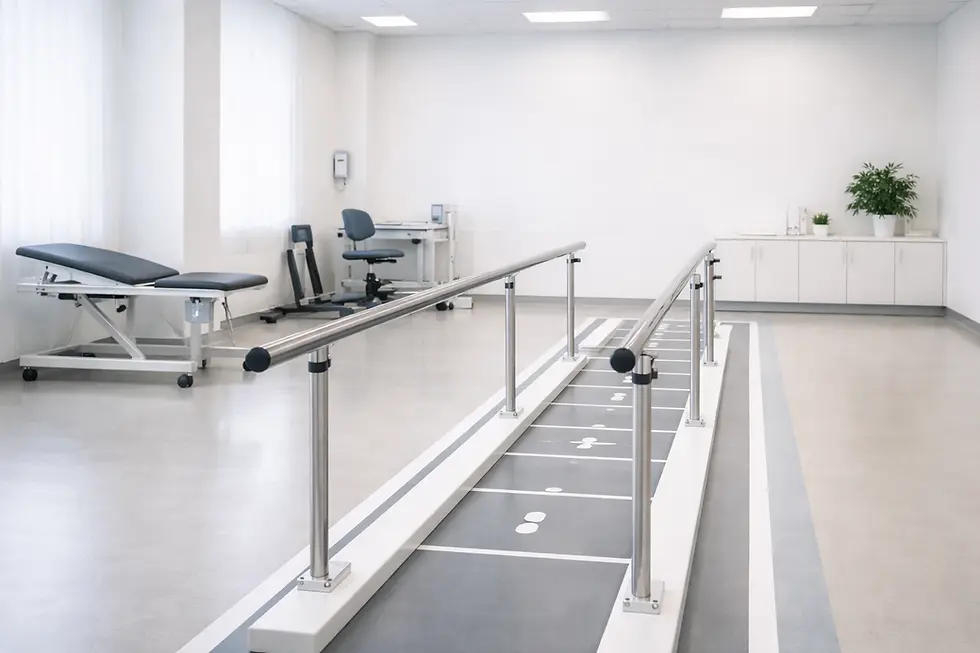
exercises at parallel bars,
weight-shifting activities in different directions,
gradual progression to assisted walking (walkers, crutches, canes).
When necessary, orthoses and supportive belts are applied. Training for stair climbing and curb negotiation is introduced only after stable walking on level surfaces has been achieved.
Scientific Evidence on the Effectiveness of Physiotherapy in DMD
Randomised Controlled Trial (1 year)
A study involving 27 children with DMD demonstrated that combining standard physiotherapy with a home-based program actively involving family members resulted in better preservation of distal and overall motor function, as measured by the Motor Function Measure (MFM) scale (p < 0.05).
Other outcome measures (Timed Up and Go, 6-minute walk test, Vignos and Brooke scales) did not show statistically significant changes; however, a trend toward functional stability was maintained.
Conclusion: family involvement and regular home-based exercises are of key importance.
Systematic Review and Meta-Analysis of Exercise in Muscular Dystrophy
An analysis of 13 randomised controlled trials (617 patients) showed:
no significant increase in muscle strength,
a moderate but statistically significant improvement in walking endurance (mean increase of +17.36 m),
minimal changes in fatigue and motor skills.
These findings confirm that the primary goal of physiotherapy in muscular dystrophies is not strength gain, but preservation of function and endurance.
Meta-Analysis of Physiotherapy in DMD (22 studies, 1,487 patients)
The results demonstrated that physiotherapy:
improved scores on the NSAA scale (+3.2 points),
reduced the risk of lower limb contractures by 29%,
slowed the loss of joint range of motion (particularly at the ankle and knee joints),
significantly improved quality of life (PedsQL +6.4 points).
The most effective interventions included:
daily stretching (≥5 times per week),
moderate resistance exercises,
aquatic therapy,
combined aquatic and land-based programs.
Conclusion
Physiotherapy in Duchenne muscular dystrophy is not curative in an etiological sense, but has proven effectiveness in:
preserving motor function,
slowing the progression of contractures,
maintaining joint range of motion,
improving endurance and quality of life.
The best outcomes are achieved with early initiation, regular sessions, individualised load selection, and active family involvement.
Current evidence confirms that physiotherapy should be regarded as an essential and lifelong component of multidisciplinary management for patients with DMD.
Discuss a comprehensive support program for Duchenne muscular dystrophy.
Physiotherapy is part of an integrated medical approach aimed at preserving function and quality of life in patients with DMD. An individual medical consultation allows evaluation of whether a comprehensive, multidisciplinary program may be appropriate in your specific case.